Eindhoven as a home base and workshop
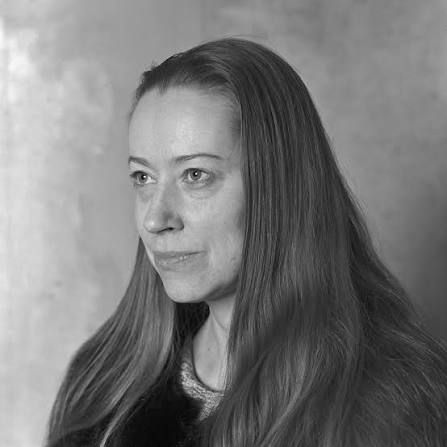
Hanneke grew up in Eindhoven, moved away to study and later returned. These days she especially values something that is not a given in a city: calm. Eindhoven feels easy-going to her. Many ideas emerge at home or during a walk in the park. Other projects need the opposite: the bustle of the city. For Koffie met Kletskoek, for example, she gathers material from conversations, people and small situations she notices while having coffee somewhere.
“The calm gives me room to think and sketch in my head, while the city sometimes gives me material.”
That combination of calm and activity also shapes her personal map of Eindhoven. She likes wandering through green spaces, visiting the places where jackdaws gather and bringing them unshelled peanuts. If she were to show someone her Eindhoven, the Evoluon would be high on the list. She describes herself as “a little bit in love” with its futuristic UFO shape. MU Hybrid Art House at Strijp-S is another place she keeps returning to: work that is allowed to be strange, hybrid or futuristic fits her own curiosity.
Her workspace is part of that sense of being among makers too. According to Hanneke, her new studio at TAC immediately feels more like a creative home base. Not just because she can work there, but because other makers are around her. For someone who has sometimes experienced loneliness in a previous studio space, that creative bubble makes a noticeable difference.
Art you encounter along the way
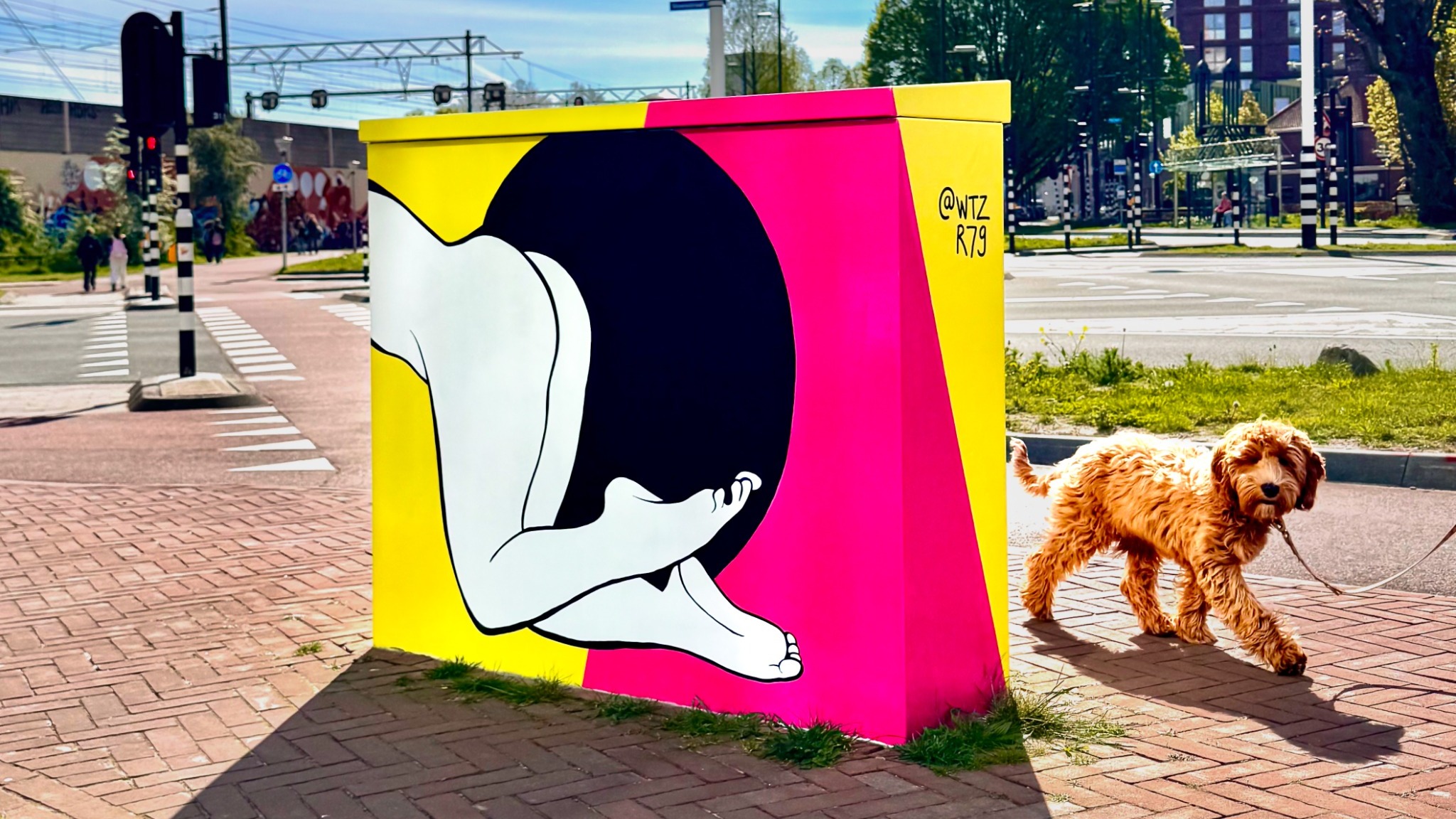
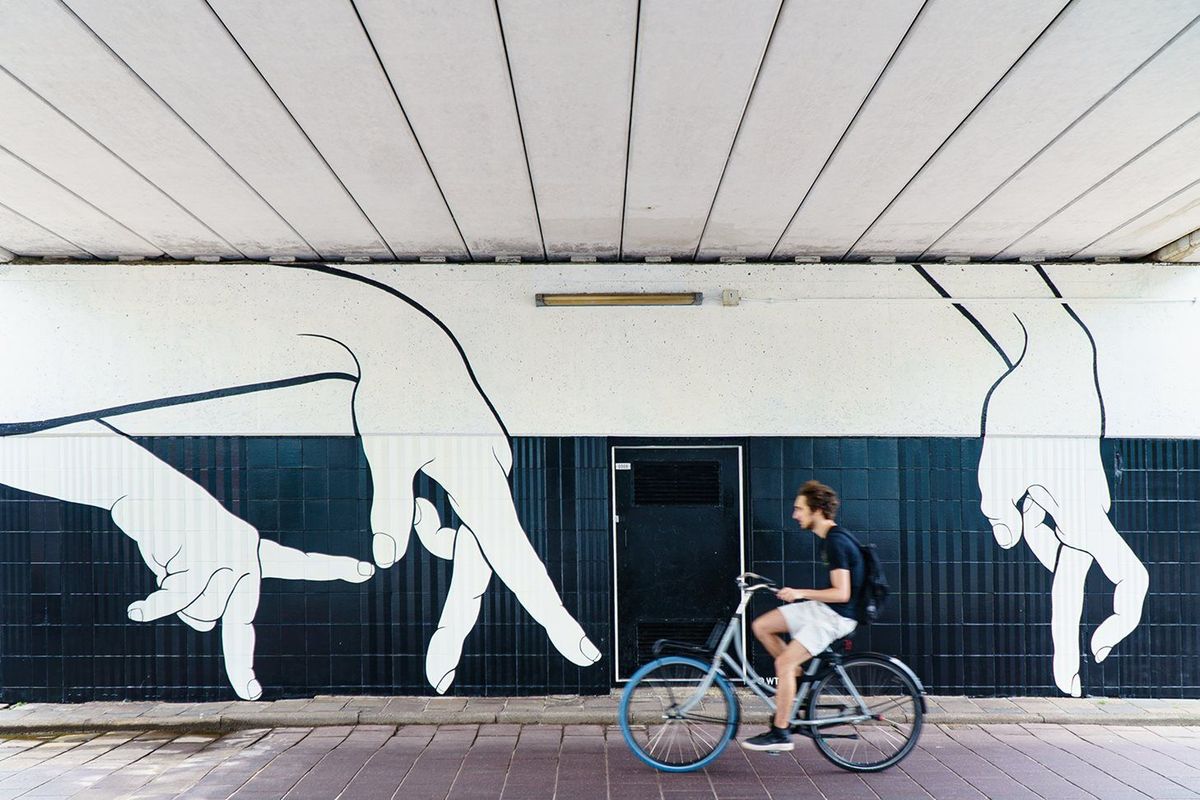
For Hanneke, public art is at its best when you do not have to make a special trip to see it. A work can become part of a route someone cycles or walks every day. That is now literally true of her work in Eindhoven. Around Fellenoord she created foot murals connected to the Walk the Walk project; at Neckerspoel, Walking Hands followed, a large mural derived from her Beings. She has also painted several utility boxes commissioned by the municipality.
“The work becomes part of its surroundings, and therefore a small part of someone’s everyday life.”
She notices that this visibility has an effect. Strangers recognise the boxes when she tells them what she makes. A resident of Strijp-S even contacted her when one painted box was due to be replaced, asking whether he could have the work in his home afterwards. For Hanneke, that may be the most beautiful kind of reach: not that someone knows the artist’s name, but that an image has quietly become familiar.
In her view, Eindhoven offers relatively generous space for projects like these. Tunnels and technical boxes that would otherwise remain grey are given their own identity. At the same time, she sees a next step: involve makers earlier in new area development. Not only once a place is finished and still needs “something creative”, but while people are already thinking about the atmosphere and identity of a new neighbourhood.
Curious about body and mind
The recurring presence of the human body in her work is not a random stylistic choice. Before studying illustrative design, Hanneke started a degree in Health Sciences in Maastricht. She was doing well academically, but realised her heart was elsewhere. Her fascination with people remained. As a child she was already captivated by her mother’s anatomy books; her mother worked as a district nurse. Hanneke has been drawing since she was old enough to hold a pencil.
“My studies did not give me a particular visual language so much as a way of looking: curious about how people are put together, both literally and figuratively.”
That way of looking still matters more than the medium. Sometimes it becomes a drawing, sometimes photography, sometimes a public commission. The recurring question is always: why do we call one body, behaviour or appearance normal and another unusual? And what happens when you loosen those first categories for a moment?
Beings: drawing without a safety net since 2016
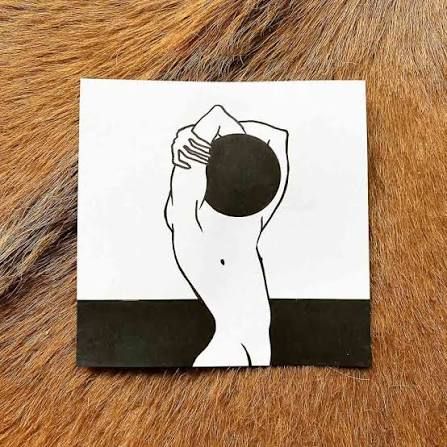
On 1 January 2016, Hanneke drew her first Being. Since then, she has made a new figure every day, directly in pen on paper and without a preliminary sketch. There is one more rule: no Being is ever thrown away. That restriction became a way to train her perfectionism. As a younger maker, a small mistake could be enough to start again. With Beings, that is not an option.
During the interview, Hanneke jokingly calls the rules a form of self-therapy. She had to learn that a line moving differently from what she had imagined was not automatically wrong. In fact, drawings she herself had doubts about sometimes turned out to be exactly the Beings someone else wanted to buy.
“My own judgement of what is right or wrong is not automatically the truth.”
The series is therefore about drawing and people at the same time. Every Being has a different body, posture or form of intimacy. People now also ask Hanneke to draw their own body as a Being. Sometimes they tell her afterwards that the image feels like recognition or affirmation: a small piece of proof that they are allowed to be who they are. She considers that one of the most beautiful aspects of the project.
A body can simply be a body
Nudity, intimacy and sexuality regularly appear in Hanneke’s work. Not because she deliberately seeks a reaction, but because the body is a direct and human visual language for her. We are all born naked, she says. She therefore sees no reason to automatically treat a drawn body as something a viewer should look away from.
“To me, artistic freedom means I can show the body without having to justify it in advance.”
She believes a work is allowed to create some friction. The invitation lies mainly in what happens next. At first, someone may see only “nudity”. If they keep looking, they may also see vulnerability, humour, beauty or humanity. That connects with the artist statement on her website: work should reward curiosity. The longer you look, the more there should be to discover.
When the street talks back
Freedom in public space does not mean an artist simply places anything anywhere without context. For commissions, Hanneke presents a fairly developed sketch beforehand. Approval of that sketch matters to her precisely because people cannot choose whether they encounter a work on their daily route. She therefore deliberately considers the surroundings and the audience. For the foot murals, for example, she added children’s and baby feet; on one utility box she drew a mother and child.
On another box, she deliberately left space at the top for stickers and tags. People who want to leave something behind are given a place to do so without immediately working over the image. It is a small detail, but it says a lot about the way she sees the street: not as a blank sheet belonging to one maker, but as a shared environment.
Sometimes that environment responds differently from what she hoped. A box with a mother and child had a large cross drawn over the image. That affected her because, to her, the vandalism did not seem to be engaging with the image at all. A second incident felt different: someone drew a bikini top and bottoms over a nude female figure. She would still have preferred that not to happen, but this time she also had to laugh.
“With the second one, I mainly thought: apparently my work stirred something in you.”
Beyond the first glance
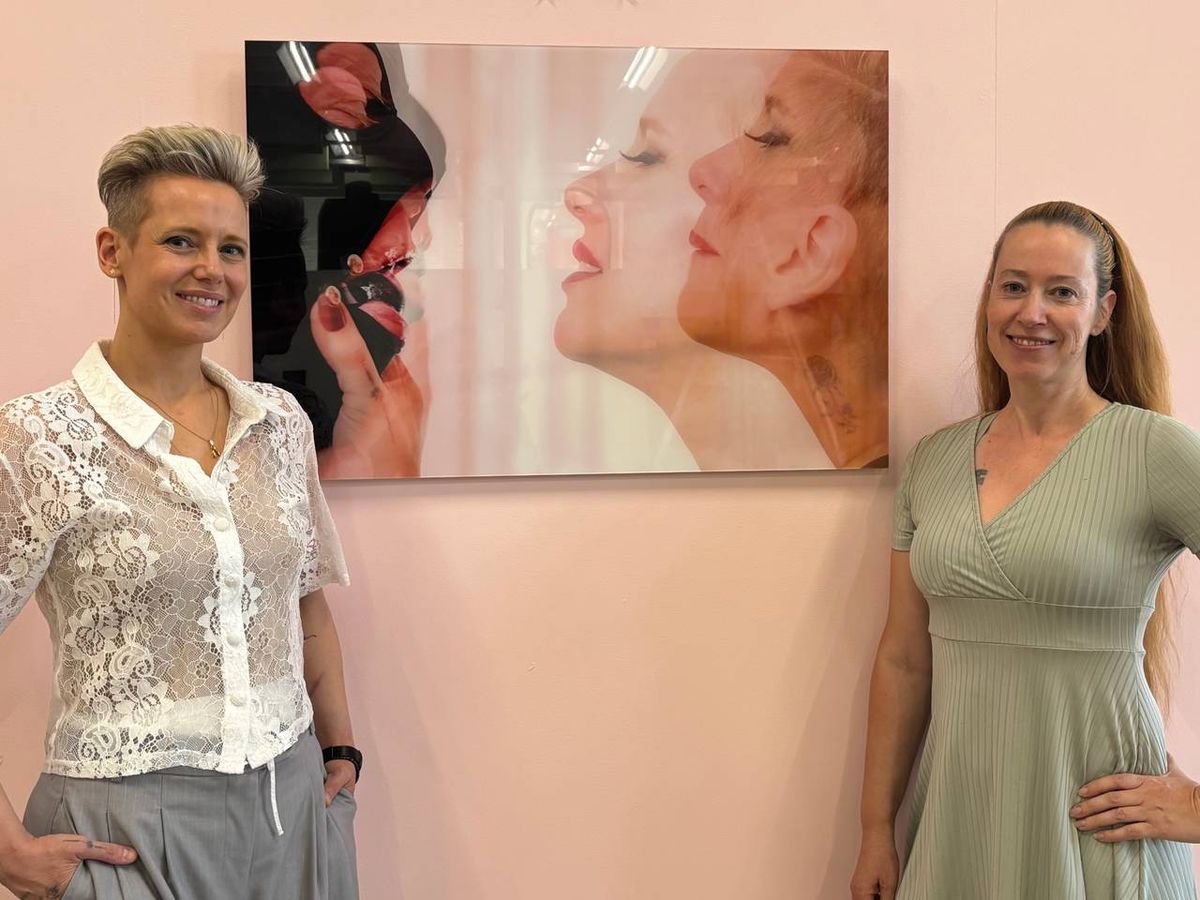
That willingness to reconsider her own first reaction also runs through her photography. For Sexhibition, Hanneke was paired with Mistress Eve. During a BDSM session, she created images for the triptych Intimiteit in Overgave (Intimacy in Surrender). A moment that looked painful from the outside initially made Hanneke feel sorry for the participant. Almost immediately she had to correct herself: the participant had chosen to be there and could experience the moment very differently from what Hanneke, as an outsider, assumed.
“What I see from the outside does not automatically tell me what someone experiences on the inside.”
That is why the project focuses not only on tension, but also on consent, trust, gentleness and care. At the time of this interview, the triptych is part of Sexhibition at Willem Twee in ’s-Hertogenbosch, on view through 25 October 2026.
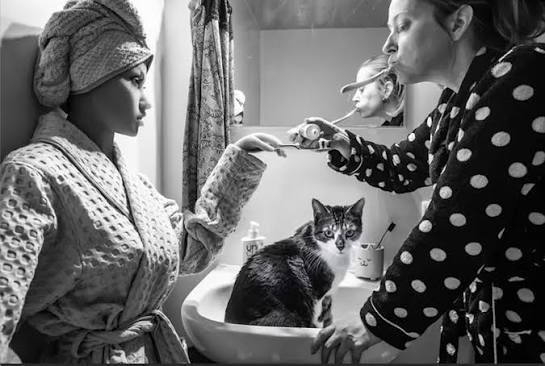
The same principle — not revealing everything at first glance — is present in Living Alone (Together), the photo series Hanneke made during lockdown with Nadiah, a life-sized doll. The sets contain small details and visual “Easter eggs” that you may only notice later. Hanneke calls a set like this a small museum of her brain. The photograph therefore becomes more than an image you understand in a second; it becomes a world in which there is still something to discover.
What other makers can take from Hanneke
Hanneke once chose to study illustrative design because she thought her drawings needed more: more background, more depth, more elaboration. During her studies she explored all kinds of ways of drawing and designing. In the end, she returned to the simplicity she had started with. Minimalism was not a shortcoming, but her own language.
“Minimalism was not a limitation I needed to get rid of, but something that genuinely belonged to me.”
That also shapes her advice to emerging makers. Keep working on something that excites you, even if you do not yet know exactly where it is going. Not every step has to be part of a carefully worked-out career plan. By making, trying and continuing to look, it gradually becomes clearer what you keep returning to.
“Instead of constantly thinking about what others expect, I want to keep making what I find interesting.”
And that is where Eindhoven comes into view again. A city cannot tell makers what their style should be, but it can offer places, commissions, studios and encounters in which they can discover that style. For Hanneke, Eindhoven as a city of makers therefore exists not only in visible murals and painted utility boxes. It is also in a studio where other makers work next to you, an experimental exhibition at Strijp-S and the freedom to take an unexpected idea seriously.
A square that keeps starting over
If Hanneke could make a new work for Eindhoven tomorrow with no restrictions, she would surprisingly not choose a monument that must remain untouched. She dreams of a huge square as a shared colouring page: a playful landscape with animals and unexpected everyday objects, with enough empty space for passers-by to colour, add patterns and draw themselves.
The colours would be temporary. Eventually the rain would wash them away, allowing everyone to start again. Something added today by a child, visitor or maker could disappear a few days later and make room for something new.
It fits exactly with the way Hanneke thinks about making. Not everything has to be perfect, not every image has to be finished at first glance, and a city becomes more interesting when residents and makers are allowed to add something to it together. Perhaps that is also ultimately her view of Eindhoven as a city for makers: not one fixed final image, but a place that keeps changing because people dare to look, respond and make.
Want to see more of Hanneke Wetzer’s work? hannekewetzer.com · Instagram: @wtzr79
Relevant websites and projects
More about Hanneke Wetzer and the places and projects mentioned in the article:
Hanneke Wetzer — official website
Beings — Hanneke Wetzer
Living Alone (Together)
Instagram @wtzr79
TAC Eindhoven
MU Hybrid Art House
Willem Twee